Saturday, February 17, 2007

Beer O' the Moment - Southampton Double White


Southampton Publick House
Double White Ale

Plenty to like here. Let's see...it's contract brewed by Olde Saratoga for the Southampton Publick House, a venerable Long Island bar and brewpub (and one of the few good things about that damned island, if you ask us). It's a frickin' Imperial White (or wit bier), which is kind of awesome. It's delish. Beer Advocate places it as 7.0% ABV and 89% give it their approval. We picked up a 22 oz. bomber for $4.99.

What the Brewer Says:
Light in color with a refreshing orangey tartness and a
hint of coriander flavor. There is also a detectable alcohol "warming" that is
balanced by a pleasant residual sweetness. og: 16.8 abv: 7.2%

What the Liberal Media Says:

You can find a mass-market beer on any grocery shelf. But
Don Sullivan, owner of Southampton Publick House Brewery, hopes those yearning
for something special might instead reach for his newly released Double White
Ale. Light in color, with a taste that hints of orange and coriander, this
ale already has earned the No. 2 spot for Belgian-style white brews in the
rankings by RateBeer.com, an online community for beer enthusiasts.
A seasonal beer in our portfolio, Sullivan says it once was only available at his
Southampton microbrewery and restaurant (and maybe at a few select bars and
restaurants in the region.) But now Double White Ale is Publick House's third
bottled brew to be widely available at supermarkets, gourmet shops and beverage
outlets in New York and four other East Coast states. But Sullivan and
brewmaster Phil Markowski have a bigger agenda. With its India Pale Ale due for
release Sept. 15, and another by spring 2006, Publick House aims to be the
nation's next Sierra Nevada Brewing Co., in other words a runaway success. In 10
years, it hopes for full nationwide distribution.
The experts think Publick House stands a chance - if it navigates the challenges of mass distribution. They are really in the right arena, says Kristen Wolfe Bieler, editor of Beverage Media in New York. The beer industry in general, which is heavily dominated by major brewers (Bud, Coors, etc.), is really struggling. The majors haven't been as innovative as they need to be to retain drinkers and have failed to release any exciting new products.
The segment of the beer industry that is growing is small, specialty brewers, which means Publick House is competing in the most interesting subcategory of the beer industry. Their taste profile (at least the White Ale) won't present a difficult trade-up for consumers looking to upgrade from a less expensive beer, Wolfe Bieler estimates.
Back in Southampton, Sullivan says that's been the case already, at least from his
anecdotal evidence. From out-of-town patrons he hears We wish we could buy this
in New Jersey or Pennsylvania. Widespread interest in specialty brews - combined
with the explosion of flavored waters and vodkas, and the variety juices now
available in low-acid, pulp-free, and vitamin enriched options - prompted
Sullivan to bottle his own special beverages for a thirsty marketplace.
With nine-plus years as a microbrewer, Sullivan is convinced he's established enough
brand awareness and feels comfortable to test the market with bottled
products. While other microbrewers closed during the 1990s, in part because
of over-expansion or poor management, Publick House stayed focused on its
brew. Our mission is to create a unique style line of beer, Sullivan says.
The restaurant is an accessory to the brewery. If the beer is less than great,
you'll forever lose that consumer. Publick House models itself after European
brewers who are much more in tune with seasonality than Americans, Sullivan
said. It's the same approach embraced by American chefs. What restaurant doesn't
talk about fall, with squashes, pies, he adds. Similarly, his brews follow
harvest patterns. In fall, it's time for Octoberfest Lager and Pumpkin Ale, and
in winter, it's French Country Christmas Ale. Following the seasons is a back
to basics approach, which Sullivan honors with his 22-ounce bottles that are
styled after those used during World War II. This larger bottle signals to
consumers that the brews are different than traditional beer.
The brews are bottled at a contract brewer in Saratoga in small batch, limited production (Publick House only made 1,000 cases of the Double White Ale, for instance.) Much like a cherished summer fruit, once the inventory is sold, that's it until next year, Sullivan says. As for its plan to go national, Michael Smith, a
national craft- beer importer in Los Angeles, warns the New Yorkers that they
face a monumental task. National distribution is very daunting, he says.
There is a climate of contraction in the distribution trade. Small distributors
are going out of business or are being bought out by the big
guys.

Copyright 2005 Dolan Media NewswiresProvided by ProQuest
Information and Learning Company. All rights Reserved.


There you have it. We report, you decide.

A Taste of Brooklyn


Here we thought these sorts of events were reserved only for the ultra sophisticated New York City socialite folk. Apparently, the trend has spread as far as Smallbany. This is a little pricey, we'll give you that, but it shore do sound nice. As if that weren't enough, Mr. Garrett Oliver, one of our heroes (we saw him in person once!), will be the host.

1st Annual Beer Dinner hosted by the World renowned Master Brewer Garrett Oliver of The Brooklyn Brewery
Thursday March 1st 2007 6pm

1st Course:
Asian mixed green salad – Fresh field greens with fried wontons, mandarin oranges, grape tomatoes, and toasted coconut and sesame seeds with our house-prepared balsamic vinaigrette
Brooklyner Weisse


2nd Course:
Broiled Cedar Plank Salmon – Fresh seasoned
salmon with a delicate lobster cream sauce
Brooklyn Local 1

3rd Course:
Grilled Angus Sirloin – Angus beef Char grilled and sliced with caramelized onions, button mushrooms, warm au jus, home made onion rings and honey dill carrots
Brooklyn Brown Ale

Artisanal Cheeses
Pleasant Ridge Reserve
Colston-Bassett Stilton

Brooklyn Monster 2005

Dessert:
Chocolate cake with warm caramel or raspberry sauce
Brooklyn Black Chocolate Stout 2006


$55.00 per person, reserved and paid in advance tax and gratuity included
Purchase Tickets At:

1814 Western Avenue
Albany, NY 12203
518.452.5670
http://www.cabernetcafe.com/

Tuesday, February 13, 2007

Beer O' the Moment - S'Muttonator Doppelbock


Smuttnose Brewing Co. Big Beer Series
S'muttonator Doppelbock

Good stuff, this. Very smooth, and malty in a good way. Apparently it packs an 8.5% ABV wallop - BA puts it at 9.8% - but we wouldn't really have guessed it. Been sitting here watching the telly and waiting for the heaps and heaps of snow to come, and we ended up nursing this baby for almost two hours (it was in a 22 oz. bomber, we haven't become that pathetic). Anyway, we certainly got our $3.99 out of this one. German beers aren't necessarily our favorite, but this, like almost all of Smutty's offerings, comes recommended.

What the brewer says:

S'Muttonator Doppelbock - S'Muttonator is once again back on the shelves and perhaps a bit is in the old belly, eh? It's been interesting trying to be creative brewing a style that has a fairly narrow interpretation in terms of historic examples and modern guidelines. My first real knowledge of this style was drinking Optimator. I love that beer. I used to drink three or four while cooking dinner for my housemates at Compound I in Oakland (OakTown Get Down, yeah!) I was working at Golden Pacific (the cellars of hell) and living in a collective warehouse that was in the old Jelly Belly factory. What great karma (or would that be plump karma?) I'd head down to the (original) Berkely Bowl, get my veggies and load up on the Spaten goodness, crank some Ween and proceed to drink my way through making a meal for ten. A drinking cook is a happy cook Mama J used to say. It's such a great sipping beer and a fine complement to food. So with those memories on my mind and palate, I think last years version was really close to what I like in a double bock, big and malty. The main thing I changed this year was to drop the starting gravity from 21 plato to 20. I thought the alcohol presence was just a bit much. I really like the balance now, though I'll probably add some dextrin malts next year to bulk up the body. My biggest issue was with our filter. It just flat out failed us. Not entirely it's own fault, I mean we have abused that sucker for years. And let's face it, it is kind of ugly and sad looking, especially next to our new(er) 8^2 meter Velo we procured from Goose Island. Ah, to have real live brewing equipment at my disposal. What a treat. It's like we're becoming a real brewery. Upwards and onwards I guess, eh?
Malt:PilsnerMunich MaltCaramunichCaraFa II
OG - 20° P, TG - 4.5° P
Hops:IBU ­ 42Bittering and aroma - Hersbrucker Hallertau
ABV - 8.5%

Monday, February 12, 2007

Top Ten Brews from Playboy

We weren't sure quite to make of this either, but upon closer inspection, it seems respectable enough. It's actually a pretty impressive panel of judges they put together (we actually know who like half of them are). We haven't tried all of these brews, and don't necessarily think all that highly of a few of the others, but it makes for an interesting enough perusal. Do bear in mind that some would categorize this as a smut site.


Playboy.com’s panel of beer experts told us their favorite American
microbrews.Here are 10 worth savoring.

Men often view beer the same way
they view sex: As long as you’re getting as much as you want, everything is
okay. But what’s the point of a large quantity of anything if you’re not also
getting high quality? Fine beers, like gorgeous women, should be savored and
enjoyed for their unique characteristics.
In the spirit of searching out
something more sophisticated to drink, we polled some of the nation’s beer
experts to come up with a list of the 10 best microbrews in America. While it’s
an impossible task to list all the deserving beers being made today in the
thousands of small breweries spread across America, this inventory of
distinctive brews should provide you with a good starting point. Unlike gorgeous
women, no good brew is ever out of your league.A panel of 14 beer experts sent us their top picks in a variety of different categories. The only stipulation was that each beer must be available in bottles (i.e. not just on tap at a brewpub) somewhere in the United States. The results of this open-ended vote were tallied and the brews that received the most votes were included in our top ten list. No favoritism was given to any of the brewers on our panel. To find out who was on our panel of experts, click here.


The Winners:


Friday, February 09, 2007

Lew Bryson Blogs!


Our countless, faithful, long-time readers are likely aware of our near obsessive devotion to the great Lew Bryson. You can imagine our elation when we learned that Big Lew had started blogging! Yup, we giggled like school girls. Lew has now been added to our uber exclusive blogroll twice over. His blog is called "Seen Through a Glass." Lew writes very knowledgably (and well) about beer and whiskey, particularly covering Philly and the Northeast. He's got some great books out, including this one, which we've been meaning to pick up for too long. Check his blog, sucka.

Wednesday, February 07, 2007

Empire Brews Back?


The one thing the burgeoning Syracuse beer scene is really lacking is a real, good brewpub. And don't come steppin' to us with the Suds Factory. Just don't do it. The Empire Brewing Co. was, by all acounts, a pretty sweet beer joint. One we didn't patronize nearly enough. Perhaps that was part of its problem (though we blame the ill-advised expansion to Buffalo and Rochester). Anyway, romours of its return have abounded almost since the time of the untimely demise. Rumours on beer dork message boards are one thing, but this comes from the Syracuse Post Standard:

Armory Square was abuzz Thursday with two developments: The Quiznos on South Clinton Street closed its doors without notice and work has begun on the former Empire Brewing Co. space that's been dormant since the popular brew pub shut down more than three years ago.
Work on the Bentley-Settle building that housed Empire included welding the metal deck that hangs over the basement space that the combination brewery-restaurant occupied. There also were workers inside the old brew pub space. The workers declined comment.
Two tenants in the building at 120 Walton St. - gold and silversmith David Church and Karin Vladimer, of the One 20 Salon - said they have heard rumors the Empire Brewing Co. itself would reopen in the space. David Katleski, one of the former owners of Empire, said he, too, has heard the rumors. He declined to comment further. Rebecca Collins, a representative for the building's owners, said the work is to repair some structural problems with the building and to prepare the basement space to be reoccupied. She declined to answer questions about potential tenants.

Empire opened in 1994. It won national awards for its beers and helped popularize Armory Square as an entertainment district. Empire expanded into Rochester and Buffalo. The Buffalo location closed a year after it opened, and the Rochester location closed three weeks before the Syracuse operation shut down in September 2003. The owners blamed increased competition and the state smoking ban for some of their problems. Katleski and his partner, Michael Hodgdon, ended up filing for bankruptcy. Church and Vladimer said they would be thrilled if Empire or another equally popular business opened in the building. "I think all the tenants suffered when they closed," Church said. "Many of us ate there. Many of our clients ate there." Both, though, said they were annoyed that the work began the week before Christmas, their busiest time of year. "It's a disaster for me," Vladimer said.
"The workers are blocking part of the sidewalk and talking up the parking spaces in front of the building," Church added. Collins, who represents 120 Acquisition Co. LLC, the building's owner, said workers had to take advantage of the mild weather and begin this week. 120 Acquisition Co. LLC's major investor is the New York City real estate firm Rossrock LLC. It purchased the building in May for $1.3 million, according to city assessment records.


Well, there you have it. Make of it what you will. We have opted for the cautiously optimistic route.

A Few Notes On Dacker


Davidson Brothers beers are bottled in Portland, Maine at the Shipyard Brewery. Not coincidentally, this is where Rick Davidson who recently returned to his role as the brewer of the Brothers Davidson, learned the art of brewing back in the good 'ol ninetees. Until recently, their IPA (a very solid beer made with Ringwood yeast - tastes like something Middle Ages or, say, Shipyard might make) was their number one seller.

And then, along came Dacker. Dacker (as in Adirondacker - noun; dude who lives in the Adirondacks) is a malty, Strong Scotch Ale that runs about 6.2%. We were blown away the first time we had it, probably because it is quite delightful on draft. The bottled version is not quite as good (again, it's brewed at Shipyard, which likely acounts for the difference). This, in the words of brew dude Rick Davidson, is Dacker's story.

Late last summer, Kerry and I had occasion to spend a few nights at the fine
Wawbeek on Upper Saranac Lake. One afternoon, I met a man and we got talking
about brewing. He’d heard of Davidson Brothers, but had never been to the pub.
Like so many people I meet, he was a home brewer, but he said he often brewed
the same recipe, one handed down to him from his father and grandfather. I told
him if he ever got down to Glens Falls, I’d like to try some of his original
ale.
The next week, he appeared outside the brewhouse door with a couple
bottles filled with his ale. I showed him around the brewery and sampled his
ale, and he had a taste of our Smoked Porter and our Scotch Ale. His ale was
very, very good and I told him so. He offered to write out the recipe if I
wanted and said we could make a batch to sell in the pub. Why not? After all, it
was exceptional. He said he didn’t want any credit or mention. He just thought
his was an ale others would enjoy. Read the rest...

Sunday, February 04, 2007

A Meandering Visit to Davidson Brothers


We know what you are thinking: there have been so few posts here, perhaps it's time they brought in freelance writers, or at least a couple of trained monkeys. Nope, not us. No need. We will simply advocate the drinking of delicious beers to others until they get so excited by the accompanying experience that they do our blogging for us! And so, without further ado, Beerjanglin' presents a visit to Davidson Brothers brewpub in Glens Falls, New York through the eyes (or words) of our latest guest blogger. Enjoy.
Editors note: we were there, too. We haven't become that lazy.


When I think about the adult that I've become, one


phrase comes to mind: "I shouldn't be this way." I've

come to realize that I am far more ignorant about
several topics than any reasonable, rational adult
male should be. I know frig-all about cars, I'm pretty
useless when it comes to home repair, I've never
really paid any attention to sitcoms, and I know very
little about beer.

Let me backtrack a touch and qualify that last

statement. Beer has played a pretty significant role
in my life. My dad's been a lifelong beer drinker, but

his tendency is to quaff cheap swill (Schaefer,
Schlitz, Meister Brau: all of these have taken up
space in the family refrigerator). So, I've always
been around beer. And, when I got to college, I

discovered drinking in the traditional manner: keg
parties and quiet soirees in dry dorms. To be honest
with you, I liked what I knew of beer - but, mostly,
it was the concept of beer as social lubricant.

I never really considered the capacity of beer, though
- sure, I'd drink stouts, brown ales, IPAs, bocks, and
what have you - but I never took the time to really
think about what I was consuming. (That being said, if
you were to take a look at my physique, you'd
understand that I'm hardly a discriminating consumer
of food and beverage in general. I like to think of

myself as being somewhat Falstaffian in nature.)

I'm working on that. I am - to quote an ever-whitening
accused child molester/moonwalker - "looking at the
man in the mirror and asking him to change his ways."
And one of the things that I'm working on is my
understanding and consumption of beer.


Hopefully, writing about what I drink somewhat will
provide me with some level of enlightenment about the
wonderful world of brews.


So, here goes. On February 3, Javen and I made an
excursion to surprisingly beautiful Glens Falls, New York
for the first of two stops on a mini-beer tour of

the northern reaches of the capital region.

Our first stop, and the subject of my initial
Beerjanglin' review, was Davidson Brothers. Davidson
Brothers is a brewpub in the heart of what would
probably be a hopping downtown district were it not

for the single-digit windchills and blowing
snowdrifts. The brewmaster, Rick, is one of the
aforementioned Brothers Davidson, and struck me as
being a gregarious individual who is extremely
consumer-friendly. He was ambling from table to table
during lunchtime, chatting up regulars and visitors
alike. He came over for a chat with Jav and I and
informed us of his "free beer" policy: "if you don't

like any of the beers, let me know, and I'll finish it
for free. Don't worry, though - I'll let you pay for
it." As he spoke, he gestured to the 6 beers Jav and I
each had in front of us.

Wait a second. 6 beers each? That's crazy talk!


Not really. Davidson Brothers has a great deal called

the "Ample Sampler." For about 9 bucks, you can get a
sampler platter of 6 5-ounce beers. You'r
e given a
card, and asked to select 6 of the 10 beers that
Davidson has on tap. The beers come lovingly arranged
on a tray - now, I've had samplers at brewpubs before
(most notably the Albany Pump Station), but this one
takes the cake.

My selections for the day were (and notes on each):

- Dacker Ale (their special recipe Adirondack Ale,
orignally conceived by a dude named Duncan Kincaid).
This was probably my favorite - it had a really great,

rich taste while being quite light. Less of an
emphasis on the hops, more of an emphasis on the
yeast. It's extremely drinkable, and I walked away

with a growler.

- Wheat Ale (a British-style wheat ale). This would be
the perfect drink to sip on a patio on a July day -
extremely light, without being watered down. Too light

for this midwinter day, though. I liked it a lot.

- Brown Ale (a traditional English brown). I like
Brown Ales a lot - they've been a go-to for me at
places like the Van Dyck and Pump Station from fall to

spring. This was decent for a Brown, on the sweet
side. I would consider this to be solid but generally
unspectacular - with the caveat that a beer doesn't
have to be spectacular to be good.

- ESB. I'm not much for extremely h
oppy pale ales, so
I'm much more of an ESB fan than an IPA buff - it
appeals more to my palate. This was a pretty good ESB,
pretty uncomplicated in nature. If this beer was a
baseball player, in the context of this beer lineup,
it'd be a middle reliever - not my first choice in
putting together a team, but definitely a necessary
part of the roster. That might not make sense to you,
but I think it's my finest analogy to date.

- Smoked Porter. You remember that Saturday Night Live
sketch where Will Ferrell, as former Cubs announcer
Harry Caray, hypothetically asked Jeff Goldblum that,
if he were a hot dog, would he eat himself? Well, if
smoke flavoring were involved, I would probably eat
myself. When you add smoke flavoring to a porter, it's
probably better than self-cannibalism (I'm just
sayin'.) I enjoyed this particular porter because it
seemed less artificially-smoked than a similar brew
that was presented at Brown's Brewing Company in Troy.
It was a far more naturally smoked porter - it didn't
just feel like the glass was rinsed with liquid smoke
prior to the pour. It seemed more...organic. And
delicious.

- The Brewer's Choice, and final selection on my
sampler, was a Belgian Trippel. Jesus Criminey, this
was strong (I want to say the alcohol topped out at
over 11%). I enjoyed my first sip very much, but made
a tremendous error in consuming a pickled hot pepper
prior to my next sip. The spice of the pepper only
accentuated the alcohol in the Trippel, which made it
difficult to appreciate anything other than the sheer
strength of the brew. I would suggest pairing it with
something sweet. I'd like to try it again under
different circumstances - perhaps with Davidson's
homemade potato chips.

All in all - Davidson's was a great experience. I wish
it were closer to the Albany/Schenectady area, but
like the Rolling Stones said, "it's a bitch." I look
forward to returning in a few months and enjoying
Rick's fine establishment.


Sunday, January 07, 2007

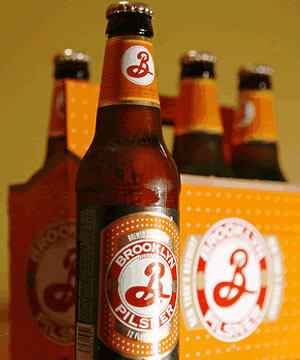
Brooklyn Brewery


NEW YORK: For journalist-turned-brewer Steve Hindy, a renaissance in the
popularity of niche beers is just one of several reasons to raise a glass.
Hindy's Brooklyn Brewery is expanding its sales into six more US states,
taking it into the Midwest and making its brews available in 18 states in
all.
And his brewery, a former iron foundry and matzoh bakery in an
industrial
section of Brooklyn, is perfecting a new Belgian-style ale:
Brooklyn Local 1,
which goes on sale in March.
"Craft beer is booming
now," Hindy said in an
office permeated with the smell of roasting barley.
The experience of the
Brooklyn Brewery, now two decades old, is being
felt throughout the small
brewing industry. Read the rest...

We wouldn’t go so far as to call Brooklyn Brewery one of our “go to” beer makers, but their stuff is, at the very least, beer that can always be counted on for a very solid product. Oh, and we have sort of a man crush on the head brewer, Garrett Oliver. We’re not sure what is most interesting to us about this story; that it was written for New Zealanders, that the founder of the brewery discovered his love for craft beer while working as an AP correspondent in Cairo, or that we learn that 80% of Brooklyn Brewery’s beer is produced under contract in Utica.

Thursday, December 14, 2006

Saranac is Finally Making Big Beers!

We think this is exciting news:


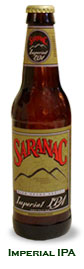
Saranac Imperial IPA (Big Beer Series)
We are pleased to announce that Saranac Imperial IPA, the first in our “High Peak Series”.
The Saranac “High Peak Series” is a series of Special Beers, limited to one single batch. These beers will be much bigger, more complex, and targeted to craft beer aficionados.This is a beer to be sipped and savored; a “real show and tell . . . blow your head off beer”
The first of our series, Saranac Imperial IPA, is brewed with 10 different hops and 10 different malts and is 8.5% alcohol and 85 IBU’s.
Look for Saranac Imperial IPA at your local retailer while supplies last! Very limited quantities!Available December 2006 in 6 packs and draught.

Thursday, November 09, 2006

We're Too Lazy to Blog

Time yourself in the 40
Tasty Suds for November 9, 2006
By Cold, Hard Football Facts sud stud Lew Bryson

Whenever I visit the cardboard-box world headquarters to beg for the money I’m owed, I always bring two things: a pound of Habersett scrapple and five 40s of malt liquor.

The scrapple’s so they’re happy to see me. The malt liquor’s so they’re still happy when I leave with every coin and paper clip I find in the pickle jar under the ammo crates the Chief Troll uses for a stool.

That bad ol’ malt liquor. We’ve all been there, drinking liquid crack. When I was in college, we used to get halves of Olde Englishe 800e because of the superior bang for the buck: Back in those days, we could get a big half-barrel drunk-bomb for 29 bucks plus tax. It works out to about 50 cents a hangover.

We didn't know we were flirting with disaster. Malt liquor has since been proven to cause poverty, rampant alcoholism, street litter, homelessness, lethal gingivitis, panhandling, religious fanaticism, racism, historical disrespect of native peoples and their culture, and Ice Cube.

Malt liquor gets a bad rap from everyone but the people who drink it. Beer geeks cry about how awful it is: “That’s not even beer,” they wail – incorrectly. Of course it’s frickin’ beer, ya dope.

Screw the beer geeks. They’re just amusing; they’re not dangerous. Malt liquor’s most serious critics are found in the halls of government and in the pulpits of churches. In their usual scenario of blaming the substance being abused instead of the abuser, “community activists” and legislators blame malt liquor for society’s problems.

Malt liquor is genocidal, the crazier ones will tell you, and the beer companies sell it in bigger containers to force people to drink enough to get drunk. It’s a way of keeping people down so they have to keep buying malt liquor and can’t climb out of poverty, despai, and the cycle of violence.

After all, where do you see malt liquor ads? Black and Hispanic neighborhoods. You never see them in suburbs. Where is malt liquor sold? In the ‘hood. If I want to buy malt liquor, I’ve got to drive almost 20 miles. They don’t sell it in my lily-ass-white neighborhood. Malt liquor is targeted at the inner city; brewers don’t even deny it.

Spare me. If I want to buy a dressed-out goat for a barbecue, I’ve got to drive over 20 miles into Philly to the Italian market. Are the goat farmers “targeting” the Italian market? Bet your ass they are: That’s where people buy goat meat.

Malt liquor is advertised in black and Hispanic neighborhoods because that’s where people buy it. It’s kind of like why all the signs in Quebec are in French; it wouldn’t make much sense to have a lot of French signs in Milwaukee. Folks buy malt liquor because that’s what they like, that’s what they want. They don’t buy it because someone’s dumping malt liquor in their neighborhood in hopes of keeping them impoverished. Don’t you think the breweries would rather they were buying something pricier?

A new example of this kind of bullshit thinking is what originally got me writing this piece. Seattle has banned the sale of about 30 “cheap” beers and wines in two “alcohol-impact areas.” See if you recognize some of these: Colt 45 (6.4 percent alcohol), Hurricane Ice (7.5 percent), King Cobra (5.9 percent), Mickey's Malt Liquor (5.6 percent), Olde English "800" (7.5 percent), St. Ide's (7.3 percent) and Steel Reserve (8.1 percent). Damn! That’s some dangerous shit!

The "cheap wines" on the list are even scarier: Cisco (18 percent), Mad Dog 20/20 (13.5 percent), Night Train Express (17 percent) and the classic Thunderbird (18.0 percent). So if they couldn’t get malt liquor before, they could get wine.

Hey, you know what? If they can’t get malt liquor or wine, they’ll get something else … like frickin’ Listerine. Big deal. Christ, if you listen to the hand-wringers, half the Midwest is in imminent danger of being blown up by suburban housewives cooking meth in their garages, and we’re worried about a couple bottles of Mickey’s?

This isn’t about cleaning up the neighborhood. This is pure bluenosed Prohibitionism. You can tell, because the proposal is about banning cheap booze. You’ll never see a proposal to ban Bordeaux or Scotch: That’s what the people proposing the bans drink.

“Those people” drink that cheap booze; they just drink it to get drunk. Yeah, like they just buy cheap used cars to get on the road and speed. They buy cheap booze for the same reasons any of us buy anything: because we want it and can afford it. And why can’t they have a drink, just like the better-off folks writing these preposterous laws?

It's like rich people never drink to get drunk. Hey, anybody ever been to a swanky country club? Giving people a place to get loaded is half the reason they exist.

The laws are preposterous, because Prohibition doesn’t work, it never does. Ban malt liquor, and people will either find another option – dope, for instance – or they’ll buy it illegally. You won’t stop the human impulse toward better living through chemistry. George Carlin had an old bit about the discovery of drugs. “The goats eat that shit, stay up all night and PLAY! You TELL me that what we’re eatin’ ain’t wrong!”

Do some of them become alcoholic bums? Sure, here are some prime examples. Some of them get drunk and get violent. Know what? Rich people get drunk and violent, too. So, too, do guys in the NFL, and what happens when they do? Rehabilitation programs and public outcry about how they’re being made an example. Hypocrisy.

Malt liquor invites hypocrisy by being so honest. It’s made cheap and it tastes sweet, because the people who drink it just want a cheap buzz. That really pisses some people off, but get off your high friggin' horse.

If you can ride with it and not fall off, who’s to say you’re a bad guy? Like Ice Cube said: “Get your girl in the mood quicker, get your jimmy thicker, with St. Ides malt liquor.” Now, who can’t be down with that?

Sunday, October 22, 2006

Guzzling Tiger Beer Catches on in Detroit

We say it's amazing what a fortuitous name and a little October magic can do for an otherwise average beer. Bet the Tigers could have used some after the way they played last night.

BY KELLEY L. CARTER, DETROIT FREE PRESS

This brew couldn’t have landed in Detroit at a better time.

Tiger Beer -- complete with a tiger on its orange-and-blue label, which matches the ball club’s color scheme -- has been moving quicker than a Joel Zumaya fastball at area bars and specialty shops.

One of Singapore's best-selling beers, it entered the U.S. market in August, just as the Tigers were gearing up for a playoff run. The timing was coincidental, and its packaging is a variation of its 1930s label.

Now bars owners and retailers are hoping to get even more of it into the hands of Tigers fans during the World Series.

"Last weekend alone we sold 20 cases, which for an off-brand beer is a ton of beer," says Harry Kefalonitis, owner of Harry's Detroit, which is near Comerica Park. "They see the sign I put up about the beer, and people will say, 'Oh, give me that. Get me a Tiger Beer,' and then the whole table ends up getting it."

The pale lager is served in about 25 bars in and around Detroit, primarily through accounts that Detroit-based beer distributor Great Lakes Beverage has close to the stadium, including a couple locations inside Comerica Park. It also is available at a handful of local specialty shops, including Royal Oak's Holiday Market. It arrives in the United States by way of its importer, Anheuser-Busch.

Daniel Haberman, co-owner of Ferndale hot spot the Bosco, said he’s been a fan of the beer for years.

“We’ve been waiting for it to come to the market for a long time just because it’s such a popular beer in Europe,” says Haberman. “More and more people are drinking it just because the Tigers are doing well.”

He called it a basic drinking beer.

"It’s like Labatt, but with more alcohol," Haberman said. "It’s nothing super special. It’s just a basic, solid tasty beer.”

Royal Oak’s Holiday Market is selling six-packs for $7.99 and pints for $2.99 until the end of the World Series. The store is bracing itself for a big weekend and has a delivery scheduled for today.

“We sold six cases in two days,” Brian Croze, wine consultant at Holiday Market. “That’s big for one relatively unique, obscure product.”

Wednesday, October 18, 2006

Flossmoor Station: A Great Place to Derail

I've been drinking, and of course sitting here reflecting on the way the meaning of the phrase "beer fueled weekend" has gradually shifted in my personal lexicon over the past few years. Where once the phrase carried connotations of a man so drunk he is punching his friend in the face to wake him up because he is passed out on the couch in his dorm-suite lounge and he needs to wake up and walk the fifteen feet to his bead, it now carries the image of a man driving all over the mid-west in search of a good hike, a little dose of knowlege from a friendly brewer or two, and of course a good pint of beer.

Suffice it to say, that when I write here that my last two-weekends have centered on beer fueled jaunts, I am not about to reel off a story of complete debauchery, which I suppose means there really is no point in wiiting about them at all. But since I was raised an evengelical Christian, and I know that it is truly blessed to speak more loudly and piously about you religion at times people will care the least, I feel no choice but to press on and spread the word of my new religion, Mid-Western beer.

First up is Flossmoor, IL, home of the Flossmoor Station Brewing Co., I first became aware of Flossmoor last spring during Beer on the Pier, a beer tasting event held on Chicago's Navy Pier and featuring tasty brews from all over the mid-west. Flossmoor was one of the smallest breweries there, sharing a table with a snooty-beer vendor specializing in imported belgium ales and another small brewery from Grand Rapids, MI. But what Flossmoor lacked in stature, It's featured IPA, more than made up for in bold-hoppy flavor and good crips finish. Had we been the judges, I and my three friends, a scotch-drinker, a stout-drinker and a non-drinker, would have unanimously voted the IPA best in show. Perhaps the highlight of the show was when I kept filling out extra-tickets to win a "I got de-railed at Flossmoor Station T-Shirt", size large, and I after I won, and announced there was no way I could wear this, having some 400 pound dude offer me $10.00 for it so he could give it to his 300lb girlfriend. I wanted fifteen but Icouldn't budge him, so I wandered back out into the city firmly resolving to visit Flossmoor if I ever got the chance.

Two weeks ago that chance finally game, a beautiful fall Saturday with nary an entertaning college football game on the slate, and so it was that after a short excursion to the wilds of the Medwine National Prarie and a harrowing experience with some evil looking bugs, I found my self making the short drive from Joliet over to Flossmoor more than ready for another taste of that heavenly IPA.

The brew pub itslelf is nestled in the heart of a mid-western suburban, and while it wasn't hard to find, it certainly was a kick to find myself driving past cul-de-sacs and down curvy tree lined streets confronting the ghosts of my childhood. When I finally emerged from my own haunted thrill ride, there was Flossmoor station right off the Metra commuter tracks, occupying an old remodeled train station. I was so excited to get to the beer, that I unwittingly charged up the first-set of stairs I found, across the beer garden and a backroom that was hosting a private party and directly to the bar where I promptly demanded the sampler.

While I was waiting for the sampler, I finally got around to reading the beer list, and my heart nearly sank to my shoes when I saw that the IPA was not currently on tap. The dissapontment was short lived however, when the bar tender arrived with my sampler tray of 12 four ounce glasses of beer. I will save you the touble of detailing my experiences with each different beer, all of which you can read about here, and just say that I dived in whole-heartedly only half worrying about having to still drive some 30-miles back to Chicago.

Maybe it was the fact that months of anticipation had led me to hold Flossmoor to unreal expectations, or maybe it was because I was tired and still a little hungover when I started drinking, but whatever it was, right off the bat, I was more than a little disappointed. The first few beers I drank just didn't seem to have any sort of distinguishing character or style, and that's not counting the Zephyr Light, which I had already written off as the annoying substitute beer all brewries out here seem to have for the frat girls who walk in and insist that they only like Miller Lite.

It was somewhat shocking for the Station Master Wheat to not immediately hit the spot on a hot day, and while the raspberry and cherry ales certainly held their own as curiosities, they did nothing to distinguish themselves from other fruit beers. There was a seasonal nut brown that I liked right from the stout, but on intial tasting the Pullman Porter had that sort of metallic-coffee taste that a not quite perfect porter sometimes acquires.

After about 20-minutes of sampling, I was watching the toy train traveling in circles above the bar and back behind the brauhaus and contemplating the best way to kick myself on a barstool for ruining my own personal myth of Flossmoor. I noticed that I hadn't touched the Panama Red Limited and half-heartedly lifted it to my lips. In an instant a star was born and things started looking up. It isn't often that one finds a red ale infused with nine types of malts and four types of hops all perfectly balanced. It was all I could do not to chug it all down, but there was still more to try, and now that there had been some time for them to breathe a few more of the brews started to come alive.

As I made my way through round number two of the Sampler the flavor of the Iron Horse Stout was finally beginning to build some momentum as it chugged down my throat, warming my body with a hearty roasted malt taste, and the Pullman Porter certainly did a good job of carrying away the baggage it had deposited only a few minutes before. But the hidden gem out of all of these brews was the aptly named Gandy Dancer Honey Ale, an American Pale Ale infused with honey that literally dances on your taste-buds.

30-minutes later, after a nother full pint of the Gandy Dancer had lightened my fee even more, I floated out of Flossmoor, firmly resolved that soon I would be bringing a group down on the train, and so excited about the growler of Panama Red I was carrying home, that I forgot all about checking my directions and ended up on a 35-minute detour that carried me east to Indiana and back west again before I finally got myself back on the right tracks.

I had been derailed at Flossmoor, and the trip couldn't have been better.

Tuesday, October 17, 2006

Expanding Our Horizons


Wisconsin on tap: A road trip with a brew

A little somethin' from the Chicago Tribune for our Midwestern readers. We think this a region that often gets overlooked, with all the love on the coasts. Reading it makes us itch for a roadtrip for some reason. It also makes us thirsty.

It was "a hobby gone horribly awry."

That was the typical response I got from brewers during a series of microbrewery road trips around Wisconsin that lasted from April into July.

I called it the ultimate pils-grimage, a sacred journey to meet the brewmasters and sample the suds at the state's 70-plus breweries and brewpubs. From my home in Madison, Wis., I hit all but a few of them in a half dozen looping trips. I also learned some related local lore, like where the fresh cheese curds were and who was doing the Friday fish fry.

My first road trip for beer was back in the late '80s when a group of college buddies and I set off from Green Bay on a two-hour drive to Stevens Point with the sole intention of touring the Point Brewery. At that time Bilko, a retired brewery employee who led the tours on Saturday mornings, prodded me in the shoulder with a finger as he asked, "And ya know what kraeusening is, don'tcha?" I had no idea.

This series of trips began with a map of Wisconsin, on which I marked up the locations (Dallas, Wis.--who knew?) of various microbrewers and brewpubs, with the intention of creating a road-trip guidebook (see end for information).

Whether you are just popping up to Milwaukee or Madison for the day, or taking a long weekend up in Chetek, Minocqua or Door County, there are beers here that any beer fan should not pass up a chance to try. Many of these brews you won't find even at a liquor store across the street from the producer.

All the breweries except Rush River Brewery in Maiden Rock have some kind of tour and samples. Nearly all the brewpubs will give you a tour or at least chat about their system if it is very small (and it often is), but that often depends on the availability of the brewmaster. In a place like Hops Haven Brew Haus in Sheboygan, the brewmaster is also the owner, bartender, plumber and janitor.

Milwaukee, the city that beer made famous, is a good place to start. Miller still turns out barrels in seven digits every year, and few are the countries around the world where you can't get your hands on some. But there are also a good number of brewpubs in the area distributing most or even all of their production over the bar.

Sprecher Brewing Co., which started brewing in 1985, is the oldest of the microbreweries in Wisconsin, and neighborhood hangout Stonefly Brewing is the newest of the brewpubs (stop in for live music and check out the tap handles, works of metal art done up by one of the bartenders). If you have to choose, Milwaukee's Lakefront Brewery arguably has the best tour (with samples before, during and after)--and on Fridays, you can stay for the fish fry complete with live polka band.

But if you have time for more, take a ride on the Brew City Queen (414-283-9999), a pontoon boat that on weekends from mid-May through September does three-hour cruises with three stops--Lakefront, Rock Bottom Restaurant and Brewery and the Milwaukee Ale House (also the temporary home to the Museum of Beer and Brewing).

Another way to effortlessly hit multiple brewpubs is the Milwaukee trolley--the free ride passes close to Rock Bottom, Milwaukee Ale House and Water Street Brewery, as well as other major attractions downtown.

Madison is not to be left behind. The Great Dane Pub and Brewery and JT Whitney's Pub and Brewery have very loyal followings (for good reason), and Capital Brewery in nearby Middleton probably has bottles at your corner liquor store. None is to be missed. The most recent arrival is Ale Asylum where the beer is "Brewed in Sanity." Brewmaster Dean Coffey, who made a name for himself when he brewed at Angelic Brewpub, has a pale ale called Hopalicious, which caters to hopheads, and a few delightful Belgian ales that move up the scale on alcohol.

Just these pubs warrant a couple of days; add a trip to Lake Louie Brewing in the woods in nearby Arena or the Grumpy Troll Brewpub in Mt. Horeb or New Glarus Brewery (see below) to the southwest, and you could make quite a long weekend.

But if you've got more time and a full tank of gas, there are some goldmines farther afield.

Minocqua Brewing Co. is right downtown and lakeside in that popular tourist town. Besides offering great handcrafted beers it is also a great place to go for a fish fry.

If you are going all the way to Lake Superior, don't miss Ashland's South Shore Brewery or Twin Ports Brewing in Superior. If you're up here to camp, grab a growler (a half-gallon glass jug refillable at your local brewpub; pictured on the front page is one from Stone Cellar Brewpub in Appleton) and take it along.

Marshfield has a hit with Central Waters Brewery which is married to 14th Street Restaurant, the best eats in town. Mudpuppy Porter is quite popular, and if you want something really different, try their Imperial Stout--aged six months in old bourbon barrels.

And now for some Wisconsin microbrewery/brewpub superlatives and trivia:

Smallest brewery: It may surprise you (or not, considering the state), but the student center at the University of Wisconsin-Platteville offers a lager and a pale ale brewed on site.

Largest microbrewery: New Glarus Brewery--maker of Spotted Cow, Fat Squirrel and Totally Naked--rolls out about 40,000 barrels per year. They offer self-guided audio tours of the brewery. Next summer, the tours will move to a second facility on the other side of this little Swiss town, which will allow them to triple production to 120,000 barrels.

Most remote: Nicolet Brewing in the town of Florence is open only on the weekends but is a must stop. Florence is as far northeast as one can get without being in Michigan. In Florence County, every town, including the namesake county seat, is unincorporated. Brewmaster Art Lies will set you up with a fine pint and is an endless font of tales, most of them tall.

Most brewpubs per capita: If you don't count the travelers who come here for a variety of outdoors activities throughout the summer--and the Birkebeiner cross-country ski marathon in winter--Hayward (pop. 2,245) surely is a contender with Angry Minnow Brewery and Muskie Capital Brewery. As if the giant muskie at the Fresh Water Fishing Hall of Fame wasn't enough reason to come.

Where would Al Capone drink? Two of the brewpubs--Shipwrecked Brew Pub in Door County's Egg Harbor and Bugsy's Sports Bar (Brown Street Brewery) in Rhinelander--have or had tunnels leading out of their basements, and local legend has it Capone used them to escape the Feds.

Only brewery with a drive-up window and playland: Falls Brewing in Oconto Falls, which set up a brewery and bottling operation in an old Hardee's. Sorry, but neither are currently in use.

----------

Kevin Revolinski is the author of "The Wisconsin Beer Guide: A Travel Companion" (Tynan's Independent Media, $21.95). If you can't find it in bookstores, it's available online at www.wisconsinbeerguide.com.

Monday, October 09, 2006

Shipyard Brewing Company


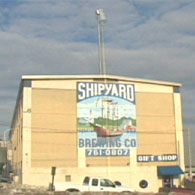
We visited the Shipyard Brewery in Portland, Maine a couple of holiday weekends ago. Might have been Labor Day, we're not exactly sure anymore. There are two things, aside from their beer, that we find very interesting about Shipyard. The brewery actually got its start in 1992 at Federal Jack's Restaurant and Brewpub in Kennebunkport (think George Bush the Elder). As demand grew, they expanded and moved to a new facility in Portland in 1994. That facility is actually located on the spot where Henry Wadsworth Longfellow was born. Shipyard has made a beer in his honour, which we look forward to trying. Sorry, but we find these sorts of things quite interesting. The second fascinating fact is that Shipyard was cofounded by an Englishman named Alan Pugsley. That, in itself might not grab you, especially since you were too lazy to click our link. Had you bothered to do so, you might have learned that Pugsley is pretty well known for his English style ales, as well as helping to design and install several dozen brewing systems in the United States, including Geary's (the first microbrewery in the Northeast - also located in Portland), Magic Hat and Middle Ages. In fact, Middle Ages founder Marc Rubenstein interned under Pugsley in Maine prior to opening the brewery in Syracuse. But we digress. Perhaps there will be more on the fascinating history of Middle Ages in an upcoming post.

So, what else can we tell you about Shipyard? Well, they make some pretty solid ales, for one. Pretty much English style with distinctive flavor from Ringwood yeast. Their flagship is a pale, Export Ale, they make a smooth IPA featuring only English Fuggles hops, and Old Thumper is an Extra Special Bitter created by Alan Pugsley's mentor, Peter Austin, and also brewed in Ringwood, Hampshire (that's Jolly Old England), and in the Orlando Airport. Yeah, you read that right. Did we forget to mention that Shipyard is partially owned by Miller Brewing and also has a small brewery Orlando, Florida? Don't hold any of that against 'em though. It's a pretty cool, pretty good regional brewery. You could do a lot worse. We happen to quite enjoy their Pumpkinhead, which is rather light and easy drinking, yet nicely spiced. Here you'll find a fairly complete link to the beers.

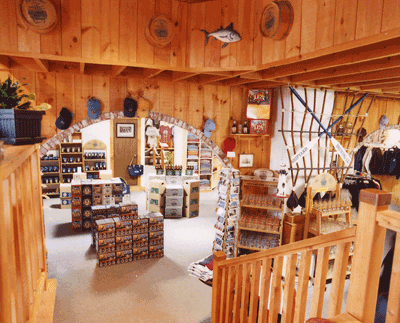
Shipyard does a fair amount of contract brewing, including several brewpubs: Gritty McDuff's and Pugsley's Sea Dog brand, Federal Jack's Tremont Ales, and Davidson Brothers, among others. They even originally did contract brewing for Magic Hat. The tour wasn't much, unless you like pockmarked, sweaty, men with heavy regional accents, who are about to knock off for the day and clearly are mailing it in. They did have an interesting video on the brewery's history (you can find that and more on the website if you click around a little). Additionally, it was free, they gave samples, and the giftshop was pretty good, so we ain't complaining. Contrary to their belief, Shipyard doesn't make the best beer in the world. They do have a good product and have certainly played a role in helping establish and maintain plenty of other breweries, not the least of which is the one in Syracuse.
We definitely have a soft spot for them.

If you visit:

86 Newbury St. in Portland, Maine!

Store Hours:
Mon-Sat 10:00-5:00 pm
Sun 12:00-5:00 pm

Brewery Tours and Tastings:
Daily, on the hour, every hour, from 12 noon to 4 pm


Sunday, October 08, 2006

The Latest From Lew

Just Because You Can...
"Any style of beer can be made stronger than the classic style guidelines. The goal should be to reach a balance between the style’s character and the additional alcohol. The brewer must provide the base style that is being created stronger and/or appropriately identify the style created (for example: double alt, triple fest, imperial porter or quadruple Pilsener)."
That’s what Garrett Oliver read to our judging panel at the Great American Beer Festival just two days ago. We were getting ready to judge the "Other Strong Ale or Lager" category, facing some big beers of 8% and up; Garrett was the table captain. The whole point of the category was to cover beers that had bulged out the top of their "base" category, the so-called "imperial" or "double" beers. (Get all the 2006 GABF winners here.)
I’m not against up-throttling beers. Doublebock came along over a century ago, and has proven itself in the marketplace and on my own happy tongue. More recently, double IPAs and double red ales have proved popular enough to have been granted their own categories. This category is kind of the proving ground for super-sizing beers.
It was our job to test the mettle of these whoppers. We faced imperial nut browns, double (or triple) pilseners, overcharged malt liquors ("What’s this," I asked, "Olde English 1100?"), and super wits. It’s easy to make fun of beers like this – and I have, in the past – but there were two disturbing aspects in the beers entered in this category.
First, this is what passes for much of the vaunted "innovation" in American brewing: turning up the volume. Honestly, I realize that it’s not as simple as just dumping in more malt. There are issues of yeast health, proper attenuation, and maintaining drinkability. But come on. What we’re talking about is a couple brewers sitting around and saying, "Damn, wouldn’t it be cool if we made a bitter at 9%? Dude, that would ROCK!"
Sorry, that’s not innovation. It’s about as creative as making a burrito with twice the stuff. Sure, you have to use a bigger tortilla, maybe even make them yourself to get them big enough, and you have to put in more spices to balance the additional beans and beef, but…putting more beans in a burrito doesn’t make it something else. It’s just a bigger burrito.
I don’t mind bigger burritos. I ate a couple whoppers while I was in Denver and I enjoyed them, much as I enjoy a well-made big beer. But when a big burrito is full of undercooked beans, or it’s blowing out through the ends because it’s got too much stuff for the tortilla, or the ingredients aren’t fresh…it’s not an imperial burrito, it’s just more sucky burrito to plow through.
That’s the problem with some of these beers. They just aren’t well-made, or even well-formulated. There are an unfortunate number of these steroidal monsters that are flabby and fat with malt. I tasted an overstrength sweet stout that used a whacking great shot of hops to cover how overly sweet the fortifying process had left it. Sweet stout with a big bitter finish? What the hell’s that?
It’s a mess. There was a "pilsner" that was hugely malty, and it was thick, heavy, sweetly hoppy, almost syrupy. Are those words you want to hear when you’re thinking about getting a pils? So many of these beers miss the point. A super witbier? What is the best characteristic of a witbier? It’s refreshing. An 8% beer is a lot of things, but "refreshing" is not usually the descriptor that pops to mind.
I’ve said before that American brewers have swung too far from the pure pleasures of lager beers. We react against them because that’s what had hammered beer variety almost completely flat in America, an unending sea of bland lagers. But we’re throwing the baby out with the spargewater: lagers are not necessarily bland, any more than ales are necessarily interesting. Believe me, I judged American "hefeweizens" as well, and that’s plenty bland.
I think we are making an equally big mistake in swinging too far from the whole German model of brewing. The Germans don’t do a lot of experimentation. They stick to making what they know, and they put all their energy into making that the best, most consistent way they know how. They don’t have a lot of variety in their beers, it’s true, but the beers they do make are very well made.
I don’t think American brewers should stop innovating. I also judged strong barrel-aged beers, and although there were a few clinkers, this is a wonderful category of beers, started only 10 years ago. But after tasting a shocking number of beers that were tainted with diacetyl or DMS, beers that were oxidized or simply stale, I do think that maybe we should remember that it’s a good idea to master the basics before trying to improvise too much.
We need to reach a compromise position between the German model and the Belgian. Innovate, certainly, but keep your focus on technique and solid formulation. Avoid the temptation to throw in more malt or hops because it would be cool. As an old girlfriend always used to say, just because you can, doesn’t mean you should.
The beer that finally won the category’s gold medal was a wheatwine from Rubicon in Sacramento. It was magnificent; complex, rich, and not cloying or over-hopped. It was a well-thought out beer. Innovative? Maybe not; wheatwines have been done before, although they’re far from what I’d call a popular style. But it was quite different, and definitely well-crafted. It was one of the better beers I had last week. Way to go, Rubicon.

We're suckers for Imperials, but Lew is usually right about these things. It's just hard to find fault with a beer that has a ton of taste and clocks in at 8% ABV plus. Unless it costs too much.

Thursday, October 05, 2006

Brewery Review: Long Trail

This being my maiden voyage, I would love to critique a brewery as a whole. I don't know if it will work or not, but let's face it: I've been drinking.

To me, breweries are like movie directors. I know that makes precious little sense, but let me explain. As an avid filmgoer, I can usually predict the quality of a given film by recognition of the director's name. Not only can I figure out how high the quality will be, but I can also determine certain characteristics of the film. When I see a Coen Brothers film, I know there will be erudite (or at least region-specific) text and a lot of nice visuals. When I hear that Martin Scorsese has directed a new picture, I expect lots of hard-boiled dialogue and a smooth cinematographical style. Kevin Smith will pander to the lowest common denominator. Milos Foreman will make an epic life story. Spike Lee will take himself too seriously and have a stupid jazz score ruining any dialogue he's written. Michael Mann will make everything dark blue. Paul Thomas Anderson will copy Scorsese. Robert Altman will have 15 characters all talking over each other at the same time. Does any of this make any sense?

Of course not. But my points still remain. Like movie directors, you can tell a lot about a beer -- even before trying it -- by the brewery it comes from. Stone is going to be harsh. Middle Ages will all have English styles. Ommegang will trigger the gag reflex (due to strength, not taste). And today, I would like to create a brief exploration of one minor microbrew: Long Trail.

Long Trail is a brewery out of Bridgewater Corners, VT, which makes a competent, inexpensive collection of seasonal brews. They are neither elite, nor swill-peddlers. It is a fine, starter beer for those of refined and pedestrian tastes. Long Trail currently has an autumn/winter twelve-pack, with four brews: Long Trail IPA (India Pale Ale), Long Trail Hibernator, Long Trail Ale & "Hit the Trail" Ale. There are three bottles of each. This 12-pack will likely cost you about $12.99 per. But let's quickly explore each one for characteristics... (I will refer to my notes)

Long Trail IPA
: Good frothy head...dark blonde color. Surprisingly sturdy hop aroma, but with a bit of maltiness thrown in as well. Very balanced hop/malt ratio... Not hoppy enough to be considered a true IPA. Very much a standard ale with a tiny little bit of extra hops...Light bodied, pleasant enough. Nice aftertaste. Definitely don't have to choke it down. Could drink several of these in a row...Should be considered a regular pale at best.

Long Trail Hibernator
: Has a dark red hue with very little head to speak of. Has a spicy, malty scent. Flavor is heavy malt, with a honey-ish touch. Very mild, much more so than most winter ales....Surprisingly nice aftertaste...As it warms up it becomes a little more cozy. Nice mild maltiness with a slight honey kick to it.

Long Trail Ale
: Nice amber color, with a thick and bubbly white head. Clear and bubbly. Small shoots of bubbles head upward toward the surface...Pleasant malty aroma...I probably wouldn't be able to pick it out of a line up, but it's got the goods. Good flavor, even if not unique. Nice at a somewhat warmed-up temp. A little bubbly on the tongue, but smooth. This is a surprisingly solid ale...Very easy to drink. It's a good beer to have between stronger ones.

Hit the Trail Ale
: An opaque reddish brown color...Nice head. Has a sweet, malty scent to it...Sweeter than most browns. Has a pleasant, malty flavor; you can tell it's there, but it's not overbearing. The malt is overpowering, but lingers on the aftertaste. A little lighter than I expected, but that fits this beer. You don't have to choke it down... Don't know if I would drink a full sixer of this particular beer, but makes a nice change-of-pace brew in the Long Trail 12-pack.

So what can you expect from Long Trail?:


Reddish or at least darkish golden color. A decent amount of head (as if there is such thing as enough). Malty flavor. Underwhelming hops. Probably a certain sweetness, or at least sweeter than most. A light, drinkable beer. Inexpensive, but not low-grade. I would say that it's a good beer to bring if you don't want to spend a lot, but want to bring a good, solid beer to the party.


Feel free to add your twelve ounces...

Tuesday, September 26, 2006

Some Different Fall Beer Ideas


These fall beers put an American twist on German flavor

This comes from Don "Joe Sixpack" Russell, Philly beer aficianado. We like much of what he has to say. This may, perhaps, have something to do with the fact that we had entirely enough Oktoberfest beers this past weekend. Or maybe because we are drinking one of his recommendations even as we type...hell, just read it.

OKTOBERFEST, THE definitive autumn beer experience, begins tomorrow with the ceremonial tapping of Spaten in downtown Munich.

If you're going to do it up right, you've gotta get your lederhosen and dirndls over to Germany and celebrate by guzzling from a stein in one of the traditional Oktoberfest beer tents.

But if you can't make it across the Atlantic, there are always plenty of well-mannered American knockoffs that faithfully observe the flavor and character of the original, orange-colored lager. Known also as Marzen beer, this is an easy drinker as the weather turns cool. It contains a bit more malt than your standard lager, and it's aged longer for a smoother finish.

But forget that stuff this year. Call it heresy, but I'm going looking for a fall beer that isn't an Oktoberfest.

And I don't mean pumpkin beer.

What I'm looking for is a nice, shapely transition from the thin-bodied thirst-quenchers of summer to the strapping headbangers of winter. If it were a woman, she'd be Katie Couric - sweet and wholesome, somewhere between Paris Hilton and Etta James.

Thankfully, in recent seasons, small brewers have turned out an assortment of fall beers that fit the bill. They're more complex than a lager, thanks to the use of ale yeast. And they're frequently spiced with more assertive hops.

On first swallow, yes, these fall beers go down with the same sweetly smooth flavor you'd find in a typical Oktoberfest. But take a second, and you discover a distinctly American twist on a standard German beer.

Here's a sixpack of American fall beers. They're mostly low in alcohol (about 5 percent), so find a friend and sample 'em all. And, sure, if you need to get into the mood, feel free to play a little oompah music.

Flying Fish Oktoberfish (Cherry Hill, N.J.).

A stealth Oktoberfest, it's an ale posing as a lager. The brewer says it's made with Dusseldorf Alt yeast, known for producing a very clean, lightly sweet flavor. Still, this brew finishes with a tart slap. Think of it as Sister Theresa with a ruler on your knuckles.

Weyerbacher AutumnFest (Easton, Pa.).

Only a sharp-eyed label-peeler will notice the tiny "ALE" printed on the bottle. If you went by looks and taste alone, you'd think it was a classic autumn lager. This is a gorgeous beer, the color of the burnt orange leaves that fall along the river drives around Columbus Day. The aroma reminds me of those hard spiced cookies Mom used to pack in my lunchbox.

And the flavor? It's well-balanced with just a bit of hop bitterness.

Sierra Nevada Harvest Ale (Chico, Calif.).

If there's a father to the harvest ale style, it's this one. Available only in limited supplies on draft, it gets its name from the late-summer harvest of fresh hops. Unlike most ales hopped with dried flowers (or even concentrated pellets), this beer's so-called wet hops are rushed straight to the brewery and into the kettle. Take a long draw from your pint, and you get the gardenlike aroma of freshly cut grass.

Redhook Late Harvest Autumn Ale (Portsmouth, N.H.).

In the words of the brewers, this is an "homage to the autumnal equinox." Try saying that after a couple of these bottles, which are available only in the East. This is yet another fall beer that is really a tribute to hops, balanced nicely with roasted German malt.

Southern Tier Harvest Ale (Lakewood, N.Y.).

This inventive western New York brewery had a little fun with a standard pale ale. The malt seems roasted, giving it a bigger bite than most pales (think Melrose Diner white toast, hold the butter). And that's a nice complement to the lemony Palisades hop flowers.

It pours gold but goes cloudy in the glass, then fills your nose with a huge, hoppy aroma.

Magic Hat Jinx (Burlington, Vt.).

Dark, but that's a deception. Yes, it's a bit stronger than most of the others in this sixpack (7 percent alcohol), and you'll detect some smokiness. But this medium-bodied ale goes down pleasantly. You'll want to pull it out at sundown on the last gasp of an Indian summer afternoon.

Full disclosure: We love the Southern Tier Harvest, not so keen on the Redhook, need to revisit the Magic Hat, and are dying to try the Sierra Harvest. As for the other two, we shall see, but we are a fan of Weyerbacher in general. For more from Joe Sixpack click here.

Thursday, September 21, 2006

It's Official: Hops are Hot (and Wet)!


This comes from the Wall Street Journal via the Pittsburgh Post Gazette via the Internet, but we found it interesting and didn't want to risk losing it.

To toast a new crop, brewers roll out 'wet hop' beer


By Conor Dougherty, The Wall Street Journal

First there was Beaujolais nouveau. Now comes beer nouveau.

The end of the growing season has been celebrated by everyone from apple growers to winemakers, but lately brewers have started marking the renewal of their own annual cycle, with beers that are brewed with hops picked only a few hours before. Called "fresh hop," "wet hop" or harvest beers, they begin appearing in late September, typically on tap and lasting only until the kegs run dry.

Harvest ales started showing up in the last decade or so in hop-growing regions like Northern California and the Pacific Northwest. But as the style catches on and more farmers plant hop yards, the beer is increasingly found outside of its traditional home. Sierra Nevada Brewing Co. sold its Harvest Ale in all 50 states last year, up from five in 2000. Late next month Dogfish Head Craft Brewery in Milton, Del., will release its first fresh-hop beer, Fed-Extra Mild, an English-style ale with two varieties of hops: one freshly picked and shipped overnight from the West Coast, and a second grown in an employee's yard. And while the majority of wet-hop beers are poured from tap handles, some brewers are now bottling it. Denver's Great Divide Brewing Co. started bottling its Fresh Hop Pale Ale three years ago, and now the brew is distributed in seven states including Texas, Florida and Massachusetts.

The season's first hops are also cause for festival-style celebration. At O'Brien's Wet Hop Beer Festival held at San Diego's O'Brien's Pub, bar owner Tom Nickel plans to serve 35 beers this year, double the number at the inaugural event two years ago. (New names at last year's festival included Hop Trip from Deschutes brewery of Bend, Ore., and Last Hop Standing from Blue Frog Grog & Grill in Fairfield, Calif.) While so-called craft brewers are leading the trend, industry giants have also taken notice: Last year an Anheuser-Busch brewery in Fort Collins, Colo., released its Front Range Fresh Harvest Hop Ale for festivals and at Anheuser-Busch tour centers.

These beers are the latest expression of brewers' obsession with hops, the sticky green cone of the Humulus lupulus plant that gives beer its bitter flavor. Classically, beer has four main ingredients -- the others are water, yeast and grain, typically barley. Before hops, brewers had balanced the sweet taste of malted barley with herbs including yarrow, coriander and ginger. Around 900 years ago they began adding hops, which imparted flavor and also served as a preservative.

Much more recently, hops became a rallying point for U.S. craft-brewers -- a movement that took off in the 1980s as a reaction to the big-brewery beers that critics dismissed as too light, too watery, and too stingy on the hops. Bitter became better for a subset of craft-brew drinkers, many of whom tend to measure a beer's worth in proportion to its hoppiness. The measuring stick is the International Bittering Unit, or IBU, with the biggest beers logging in at 100 plus IBUs. Mainstream brews from Anheuser-Busch, Miller and Coors are typically around 10 or 20 IBUs.

The hop infatuation has resulted in a game of chicken among brewers, who have continued their effort to out-bitter the next guy -- as evidenced by beer labels that boast mixed hops, extra hops or triple hops. Stone Brewing Co. in Escondido, Calif., calls its Stone Ruination India Pale Ale "a liquid poem to the glory of the hop!" Delaware's Dogfish Head has pioneered a pair of hop-enhancing technologies, including a "continuous hopping machine" that adds hops gradually over up to two hours of brewing instead of throwing some in at the beginning, middle and end, as is customary. The brewery also invented a method for delivering a final hoppy hit to kegged beer by running it through a hop-stuffed chamber before it hits the pint glass. Dogfish Head calls the device Randall the Enamel Animal, and some bars and beer stores have also started serving "Randalled" beers.

But for a few months in the fall, brewers stop worrying about more hops and focus instead on fresh hops. When first plucked from its stalk, a hop flower is green and about 60 percent water by weight. For brewing purposes, hops are usually dried and refrigerated, or made into pellets that resemble rabbit food. Wet-hop beers use flowers that have been picked just hours before, so they still possess the volatile flavors that are lost during processing. Brewers compare beer made with these moist hops to a meal cooked with just-picked herbs -- entirely unlike one made with dried oregano and parsley from the back of the pantry.

A fresh-hop beer can often, in fact, be less bitter than a corresponding version with dried hops, and instead is powered by floral, citrus tastes. The retained oils line the inside of the mouth and have a tinge of greenish, vegetal flavors. (Many brewers recommend drinking their wet hops with a glass of water.) It's easy to taste the difference between a normal brew and a fresh-hop version -- though that isn't always a good thing. "If you're not careful you can end up with a beer that tastes like lawn clippings," says Garrett Oliver, brewmaster at Brooklyn Brewery.

Brewing, of course, has a long tradition of following the seasons. Before refrigeration, beermakers were eager to get their hands on the first hops of the season. They tended to make beers in the fall that highlighted them, before switching to maltier beers as stored hops lost their character. (Germany's Oktoberfest is a slightly different story: The two-week festival now marks the fall with copious amounts of beer, but got its start as a wedding celebration.)

Randy Mosher, a beer author and instructor at Siebel Institute of Technology, a Chicago brewing school, says there's little historical precedent for using hops within a few hours of picking. "What people are trying to do with craft beer is put people in touch with their food again, and remind them that they're drinking an agricultural product," he says.

Fresh-hop beers started popping up about a decade ago when Sierra Nevada brewed its first Harvest Ale. The style attracted other brewers, and there are now several dozen versions available. Sierra now makes three wet hop beers, including one using "estate grown hops," while Steelhead Brewing Co. in Eugene, Ore., last year made a pair of fresh-hops, "Fugglerama GBP 1" and "Fugglerama GBP 2," with two varieties of Fuggle hops. There's even a nascent movement among brewers to grow their own: Today in Kearney, Neb., Trevor Schaben, owner of Thunderhead Brewing, plans on heading out to a hops field 10 miles from his brewpub to pick with a handful of customers (it's the brewpub's second attempt at a wet hop).

Though wet-hop beers inspire brewers' creative fancies, they also pose a logistical challenge. Many breweries are set up to use pellet hops, which are much easier to filter out than the leftover plant matter from wet hops. A wet hop requires a special filter or trapping system to keep the debris out of the finished product.

But the bigger problem is getting the hops in the mix before they've spoiled. Victory Brewing Co. contracts a refrigerated truck to collect hops from a grower in upstate to New York then drive straight back to the brewery in Downingtown, Pa. Come fall Russian River Brewing owner/brewmaster Vinnie Cilurzo gathers about a a dozen friends and family members to pick hops on a quarter acre plot a few miles from his brewery in Santa Rosa, Calif. As they pick he begins brewing, then throws in the hops as they arrive from the field. Sierra Nevada uses two varieties -- Centennial and Cascade -- that have different picking periods that overlap for a day or so. The brewery sends a truck to collect the last of the Cascade harvest, then to another field to collect the first of the Centennials, then back to the brewery in Chico, Calif. "I never know what day it's going to be," says brewmaster Steve Dresler.

And for brewers who don't have their own hop farm, this often means paying to have fresh hops sent overnight, multiplying their hop tab. One thousand pounds of hops from Washington state grower Yakima Chief, for example, runs about $2,800 for overnight delivery, compared with $400 for the same amount by slower shipping. Because fresh hops contain so much water, brews that incorporate them can require several times more hops by weight, boosting the price even more. Russian River charges $165 wholesale for a keg of its HopTime Harvest Ale, $50 more than it charges for its Imperial Pale Ale, and $6 per pint in its brewpub, $2 more than it charges for other beers.

But for calendar-watching beer drinkers, the once-a-year brew is worth the splurge. "It's like being able to get vegetables from the farmer's market," says beer aficionado Richard Sloan, a computer programmer from San Diego. "You better be there, or they're gone."

A Taste of the Harvest

Brewers and brewpubs will release fresh-hop beers starting in late September, mostly on tap. Here is a sampling:

BREWER/LOCATION: East End Brewing Co. Pittsburgh
BEER NAME: Big Hop Harvest Ale
COMMENT: This year-old brewery will release its second wet-hop beer this year. The Big Hop Harvest is a variation on the brewery's India Pale Ale, a hoppy brew called Big Hop IPA, but has 7 percent alcohol, compared with Big Hop's 5.8 percent.

BREWER/LOCATION: Left Hand Brewing Co. Longmont, Colo.
BEER NAME: Warrior IPA
COMMENT: Most wet-hop beers are poured from the keg; this Colorado brewery sells its variety in bars as well as in 22-ounce bottles distributed to 15 states. The beer is named for the Warrior hops the brewery gets from Washington state.

BREWER/LOCATION: Rogue Ales Newport, Ore.
BEER NAME: Hop Heaven
COMMENT: For three years, Rogue has brewed a wet-hop beer using Newport hops grown on a farm about two hours from the brewery. This year the company is switching to Centennial hops, and the resulting beer will be ultra-bitter, the brewer says. It will be available on tap nationwide.

BREWER/LOCATION: Russian River Brewing Co. Santa Rosa, Calif.
BEER NAME: HopTime Harvest Ale
COMMENT: Russian River has made wet-hop beer since 1999, with distribution mostly on tap in California. This beer has a grassy taste -- a common feature of fresh hops -- with melon and lemon-zest flavors, says brewer Vinnie Cilurzo.

BREWER/LOCATION: Sierra Nevada Brewing Co. Chico, Calif.
BEER NAME: Harvest Ale
COMMENT: Sierra Nevada has made its harvest ale for 11 years, one of the first breweries to do so. Kegs of the beer make it to all 50 states, but it still pays to live near the brewer: Sierra has other wet-hop varieties mostly for local distribution.

BREWER/LOCATION: Victory Brewing Co. Downingtown, Pa.
BEER NAME: Harvest Pilsner
COMMENT: Most wet hop beers are ales. This is a rare harvest lager -- in the Pilsner style -- that uses hops grown in upstate New York and trucked to the Pennsylvania brewery just after they're picked. Its brewer touts its "earthy, spicy" taste.

BREWER/LOCATION: Pelican Pub & Brewery Pacific City, OR
BEER NAME: Elemental Harvest Ale
COMMENT: Cool link and pics. Looks like a really interesting joint. Perhaps we shall be lucky enough to visit one day.